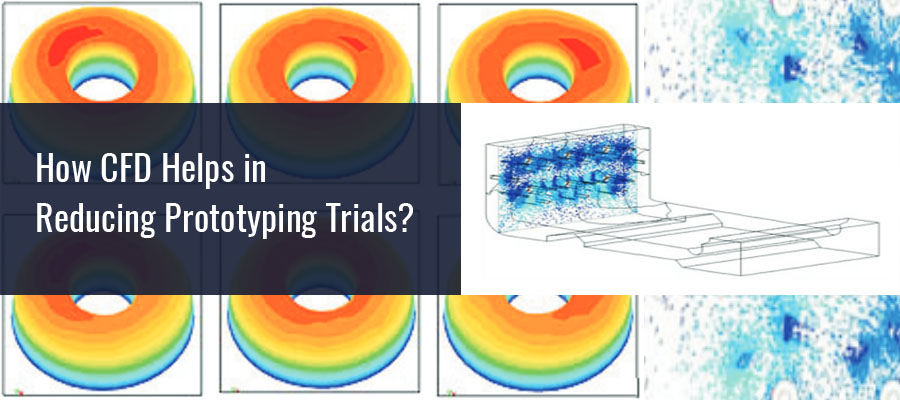
CFD is a commonly used acronym for Computational Fluid Dynamics. With the help of Computational Fluid Dynamics, it is very easy to use numerical methods to solve fundamental nonlinear differential equations that describe fluid flow for predefined geometries and boundary conditions. The result is a wealth of predictions for flow, velocity, temperature, density, and chemical concentrations for any region where flow occurs.
CFD is one of the emerging areas that are being developed since last decade. This technique has been widely used in engineering applications like automobile and aircraft design, weather science, civil engineering, and oceanography. Today HVAC industry is one of the fields that start to utilize CFD techniques widely and rigorously in its design.
Let us now look at some of the dynamic advantages of employing computational fluid dynamics:
CFD Predicts Performance Before Modifying or Installing the Systems:
Without modifying and/or installing actual systems or prototype, CFD can predict what design change is most crucial to enhance performance.
CFD Provides Exact and Detailed Information about HVAC Design Parameters
The advances in HVAC/IAQ technology require broader and more detailed information about the flow within an occupied zone, and the CFD technique meets this goal better than any other method, i.e., theoretical or experimental methods.
CFD Saves Cost and Time
CFD costs much less than the experiments because physical modifications are not necessary.
CFD is Reliable
Most importantly, numerical schemes and methods that CFD is based on are improving rapidly so that reliability on the results produced by CFD is getting very high. Increased reliability makes CFD a dependable tool in any design and analysis purpose.
May be you like to read more about : Typical Steps of CFD Simulation Process
Explore how CFD can enhance your equipment efficiency and safety
Reach out to our engineering team today.